Vernon Historical Society
Vernon/Rockville Connecticut
Historical Society
Archives
Tragedy In Vernon by Jean Luddy
Readers of the Rockville Leader must have been shocked by the headline on the Tuesday afternoon edition of August 4, 1908: “Double Murder Today.” The article was the first of several covering two murders that occurred at a farmhouse in Vernon, from the arrest of the perpetrator through his trial, sentencing and execution. (See article in Meriden Morning.) In reading the articles one is struck by the differences between then and now in police procedures, forensic techniques and the accessibility allowed the press in gathering and presenting information.
This tragedy occurred at the Dockerel Farm which was described as being located on the road to Bolton Lake about 4 miles from Rockville. John Zett, a farmer, lived in a one and one half story frame house with his wife, Mary, two sons, John and Andrew, and granddaughter Viola Kloetzer, age 5. On the morning of August 4, 1908, Andrew Zett left the farmhouse at 5:30am to take his brother John to work at the New England mill and then to complete some errands. Between 5:30am and Andrew’s return at 10:00am, John Zett seriously injured his wife with a hammer and murdered his granddaughter who were in bed a first floor room. Shortly after Andrew arrived at home, he went inside the house where his father attacked him with a hammer. The two men wrestled with the hammer before Andrew was able to seize it. His father then ran from the house to the woodshed nearby. Andrew remembered that his father kept a gun there. He followed him quickly and, using the hammer, was able to knock him unconscious. After tying his father securely with a rope, he placed him in the woodshed. When he returned into the house, he found the bodies of his mother and niece. His mother was barely alive and died within hours.
Walter Reinhold, a neighbor, came by the house as Andrew was subduing John Zett. After the discovery of the bodies, he went to the nearby Apitz farm to ask Mr. Apitz “to hitch up and go to Rockville for a doctor.” Mrs. Apitz went to the Zett farm to offer any help.
When news of the murder reached Rockville, the Medical Examiner and County Coroner were not in town. The Deputy Corner found a local doctor to accompany him to the farm. They arrived by automobile around 11am, followed shortly by Police Captain Edward Kane. A representative from the Rockville Leader was already there. Soon Dr. Rockwell, the Medical Examiner and T. F. Noone, the Prosecuting Attorney arrived to assess the scene. Later the suspect was taken to the police station in Rockville.
On Friday August 7th, the Leader reported that Zett was taken on August 6th from the Rockville police headquarters to the Tolland County Jail. That same day, Mary Zett and her granddaughter, Viola Kloetzer, were buried at Grove Hill Cemetery. Before Zett was taken to the jailhouse, a preliminary hearing was held in the police court in the Municipal Building. Witnesses and family members testified on the sequence of events, establishing a reason for a trial.
John Zett’s trial took place over several weeks in September 1908. Neighbors, relatives and town officials testified about the events of the day of the murders. Zett’s son and daughter testified about ongoing disagreements between their parents, most of which had to do with money. On the day of the murder Zett said, “I done it; she was always fighting with me. “At the trial he testified that “on occasions, they had quarreled and she had sworn at him”. He spoke of “her visits to the old country and said that on her second visit she remained away nine years.” He also said that he had not gotten along with his son Andrew. The defense attorney asked for a verdict of 2nd degree murder, saying that “there had been no premeditation, but that Zett had been so troubled by members of his family that his mind was in no condition to plan a deliberate crime. He was under unusual excitement and struck the blow on the spur of the moment.” The prosecution requested a verdict of murder in the 1st degree, stressing the fact that provocation does not justify murder.
On September 18, 1908, the jury found John Zett guilty of murder in the 1st degree. At that time the judge sentenced him to hang on December 21, 1908. Zett was sent to the state prison at Wethersfield to await his execution.
Several months later, an article in the 12/22/1908 edition of the Rockville Leader summarized the prisoner’s last days and noted that his “nerve failed him at the crucial moment after he appeared in the death house and had taken in the surroundings.” Zett was visited by a son and his daughter before his death. He was hanged at midnight on December 21st. Following the wishes of the family, John Zett was buried at the prison cemetery. (Zett was one of only 3 people from Tolland County executed in Connecticut.)
The preceding paragraphs summarize the events of day of the murders, the trial and execution of Zett. The articles from the newspaper detailed the crime scene, police courts, jail and the prison execution chamber. Interviews with family members, neighbors, officials and even the prisoner himself were taken shortly after events occurred. The reporter from the Leader was on the scene just before the Deputy Coroner, doctor and Police Captain arrived. He joined neighbors in the bedroom and described the scene, including the victims’ injuries. Through interviews, the reporter was able to construct the sequence of events that led to the morning’s tragedies and present a possible motive. “The real motive for the crime apparently is a threat on the part of members of the family that they were going to oust Zett from the farm and run it themselves. At least this is what Zett informed a Leader representative when questioned. He said that he had been told or had heard that he must leave the farm. It’s possible that had angered him, but it would not seem that he would commit such a brutal murder from such a slight motive as this.”
The article goes on to report. “When asked by a Leader representative what weapon he used in the commission of his brutal crime, Zett replied that he used a hammer, and when asked where the hammer was he said that it was in the barn. A Leader representative went to the barn in search of the hammer, but could find no trace of it.”
In the August 7th article, testimony from all who spoke at the preliminary hearing was described in detail, except for those people who had been quoted in the first article. The reason was that “Practically all of the facts as given by the witness appeared in the Tuesday’s issue of the Leader.” Information about the prisoner’s conduct in jail, the layout of his cell, and the guards’ schedule was published. The scene in the police court was not unlike that of a high-profile case today. “Although 9 o’clock was the hour assigned for the hearing, the court room was packed to suffocation long before that hour. Many found it impossible to get inside and had to be content to look through the windows from the outside. Among the spectators were a few women.” The funeral for the victims and their internment in Grove Hill cemetery were covered as well.
Several newspaper articles in mid-September kept the public informed about the progress of the Zett trial. Zett testified about his troubled relationship with his wife and about problems that he had had with his son Andrew. Articles listed everyone who testified and summarized their statements. Observations were made about people’s mannerisms and emotions. The names of people who were called to jury duty were given. The reasons for those who were excused were mentioned. The names of the final panel were published.
|
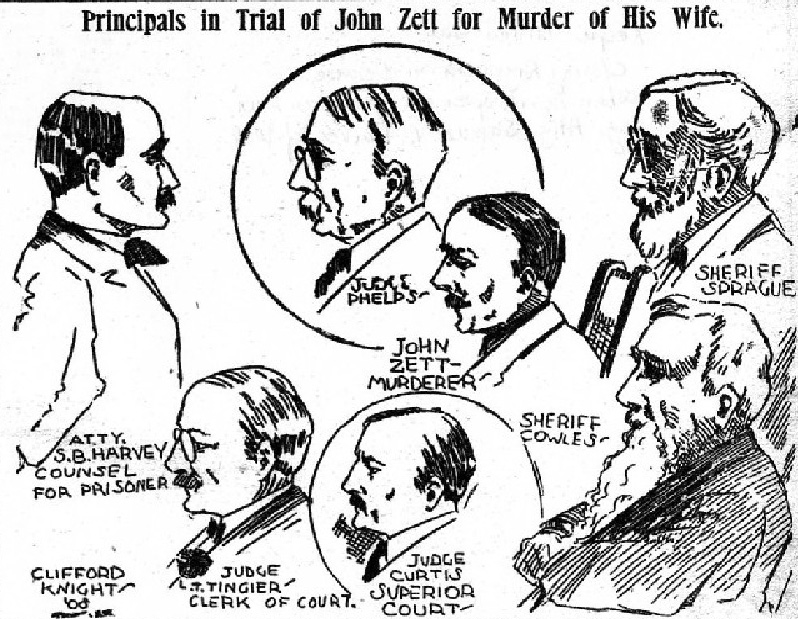
The article from September 18th which announced the guilty verdict included an illustration of people involved in the trial. The reporter described the scene before and after the verdict and sentencing.
The article from the December 22nd edition of the Leader focused on John Zett’s final days and his last moments of life. Everyone who visited him in jail and all those who witnessed the execution were named. Some spoke to the reporter, giving their assessment of Zett’s behaviors and attitude.
The Zett murders had their roots in domestic discord between a husband and wife and conflict between a father and son, problems that still exist in our society. Zett’s violent acts shocked the community, creating a tremendous interest in the case, trial and final execution. This would still happen today as demonstrated by current interest in true crime books and forensic science shows on television.
Some major differences between then and now in crime and punishment are seen in the nature of the news reporting, crime scene procedures and forensic techniques. Today, with privacy issues, concerns about pre-trial publicity, and attorney/client privilege, the press would not have as much access to witnesses, officials and suspects. Forensic knowledge was not crucial to this case since Zett admitted to the crime and handed over the weapons. However, today’s reporters would certainly not be permitted to search for murder weapons. The absence of a psychological assessment is another difference, although officials, lawyers, family members and Zett himself commented on his mental state and possible motives for the crime.
In the days before the advent of radio, television and the Internet, the newspapers served as the primary source of information for people. The reporters were the eyes of the community, getting the facts of the event and converting their observations into print so their readers could visualize what had happened. In reading the newspapers from this era, one can see that the papers did more than just report the facts. The newspapers also reinforced community values through subtle (possibly intentional) editorializing within the articles. Descriptive adjectives, like “plucky” or “fiendish” guided the readers’ reaction to the events in the article. In the final article on the Zett case, all the attorneys, judges and officials are praised for giving Zett a fair trial. By the end of the piece the reader is left with the feeling that the murderer has paid for his crime and justice has been done, bringing closure to the tragic events of an August morning.
Author’s Note: A search of land and probate records in Town Hall reveals additional information that may shed some light on Zett’s attitude toward his wife. In 1905, Mary Zett paid Mrs. William Dockerel $950 for seven pieces of land referred to as the “Dockerel farm”. These totaled more than 80 acres and were located in the southeast section of town near the Tolland border. Disagreements over money were mentioned by Zett’s children as a reason for the conflict with his wife. Having Mary as the owner of the farm where he lived might have contributed to Zett’s behavior. In 1909, Andrew Zett sold all of the property to Jacob Kozloski.
(Published in the 'NEWS from the Vernon Historical Society', September 2006)
Upcoming Events

Publications from the Vernon Historical Society


